Saiyasart glossary
Amulets, talismans, Sak Yant, kathas, spirits and rituals: the complete vocabulary of Thai sacred magic, with instant search.
Thai is not written in our alphabet, and there is no perfect way of carrying it over. This glossary follows collectors' usage — Phra Somdej, Nang Gwak, Gumarn Tong — rather than the official transliteration (Phra Somdet, Nang Kwak, Kuman Thong): these are the spellings found on labels in amulet markets, in catalogues and on specialist forums. There is no correct spelling in this field, only conventions.
The 121 entries below are those of chapter 32 of SAIYASART.
A B C D G H I J K L M N O P R S T U V W Y
A
- Agkhara
- Letters of the sacred scripts (Khom, or the Lanna variant) used to inscribe Kata on amulets and Sak Yant.
- Ajarn
- A lay master initiated into a discipline of Saiyasart, as opposed to an ordained monk.
- Amisa Bucha
- Homage paid through material offerings (incense, flowers, food), as opposed to Patipatti Bucha, homage paid through practice (chapter 29 of the book).
B
- B.E.
- Buddhist Era, the official calendar of Thailand. To convert to the Western year, subtract 543: B.E. 2512 corresponds to 1969 (chapter 30 of the book). → read more
- Bai Si
- A cone-shaped offering, mounted on a footed tray and made of folded banana leaves and flowers, presented at Wai Kroo ceremonies (chapter 20 of the book).
- Benjapakee
- The group of the five most prestigious amulets in Thailand, a ranking formalised in the 1950s (chapter 5 of the book). → read more
- Bhāgī
- A Pali term meaning "one who takes part, associate"; the second element of the word Benjapakee (see that entry).
- Bpalad Khig
- A phallus-shaped amulet inherited from the Brahmanic cult of the Lingam, worn for commercial prosperity and protection (chapter 15 of the book).
- Bpiya Metta
- The name given in the Lanna tradition to the powers of sympathy and charm, referred to elsewhere as Metta Mahaniyom and Maha Sanaeh (chapter 19 of the book).
- Bucha
- Veneration of a sacred object on an altar, as opposed to wearing it on one's person.
C
- Chao
- "To rent". The verb used in Thai for acquiring an amulet, since the sacred cannot be bought; the sum paid contributes to the temple and the object is received in trust (chapter 30 of the book). → read more
- Choke Laap
- The magical attribute of luck and material prosperity.
D
- Devas
- Deities or protective spirits of the Brahmanic pantheon integrated into Thai popular practice.
- Dhutanga
- A set of thirteen practices of voluntary austerity adopted by forest monks, concerning clothing, food and lodging (chapter 6 of the book).
- Dtukadtaa Maha Wan Ya Sak
- Figurines of clay and plant powders from whose base the Sak Yant master scrapes material to make his ink (chapter 25 of the book).
- Duang Pichai Songkram
- A great astrological and protective diagram, once reserved for sovereigns and generals, drawn on cloth and never tattooed (chapter 19 of the book).
G
- Gumarn Tong
- "Golden child": a protective effigy of the home, also transcribed Khuman Thong (chapter 15 of the book). → read more
H
- Himapant
- The mythical forest of Buddhist cosmology, populated by hybrid creatures that serve as models for many Sak Yant designs.
- Hmor Phii
- A traditional sorcerer-healer specialising in funerary rites and ancient occult practices.
- Horasart
- Traditional Thai astrology.
I
- In Koo
- A paired effigy from Lanna symbolising the union of two complementary forces (chapter 24 of the book).
- Isan
- The north-eastern region of Thailand, of largely Lao culture.
J
- Jataka
- A collection of stories of the Buddha's previous lives.
- Jerajaa
- The power of convincing speech; depending on its use, it belongs to protection, trade or seduction (chapter 19 of the book).
- Jhana
- A state of deep meditative absorption.
K
- Kaa Khaay
- A category of powers specific to the North, aimed at commercial success and selling.
- Kasina
- A material support for meditative concentration (a colour, an element, light) used in tranquillity meditation; Thai tradition regards mastery of the kasina as the condition for a truly effective consecration.
- Kata
- A sacred formula or mantra, usually in Pali, recited to activate or invoke protection.
- Khan Kroo
- The tray of offerings the disciple presents to his master: garland, incense, yellow candles, betel or tobacco, and the gift of money (chapter 21 of the book).
- Khan Kru
- In the Lanna tradition, a permanent object given by the master to the disciple, which represents the master and attests to the level reached: Khan 8, 12, 24, 36, up to Khan 108 (chapter 6 of the book).
- Khom
- An ancient Khmer script used to inscribe sacred formulas on Yant and amulets.
- Khong Kham Dong
- "Talisman for crossing the forest": the name given in the North to invulnerability to weapons, called Kong Grapan Chadtri elsewhere (chapter 19 of the book).
- Khong Khun
- A phenomenon of temporary possession that can occur during certain ceremonies, notably the Wai Kroo.
- Klaew Klaad
- A magical attribute that allows one to avoid danger rather than withstand it.
- Kong Grapan (Chadtri)
- The attribute of invincibility against weapons and projectiles.
- Korb Kroo
- The central moment of the annual ceremony, when the master places the mask of the primordial master on the head of each disciple, renewing his attachment to the lineage (chapter 20 of the book).
- Kot and Saeng
- Natural anomalies held to be magical in themselves. In Lanna, kot refers exclusively to growths on elephant tusks, saeng to all others (chapter 23 of the book).
- Krasue
- A nocturnal figure of Thai folklore, a floating female head; equivalents are found throughout Southeast Asia (chapter 2 of the book).
- Kruat Nam
- A ceremony dedicating merit, during which a thin stream of water is poured while a monk recites; the water is the vehicle, the earth the witness (chapter 29 of the book). → read more
- Kruba / Luang Por / Luang Phu
- Honorific titles given to respected monks, according to their age and renown.
- Krueang Rang
- A talisman of animist or Brahmanic origin, made and charged by a lay master (Ajarn) according to the traditions of Saiyasart, as opposed to Phra consecrated by monks (see that entry). → read more
- Krueang Rang Chapo Kon
- A personal talisman, whose power comes from a family bond and not from a consecration; it becomes universal again when the line dies out (chapter 23 of the book).
L
- Laap Sakkara
- Receiving offerings, goods and esteem in abundance; a quality whose guardian figure is Phra Sivali (chapter 9 of the book).
- Lek Lai
- A legendary mineral substance to which tradition attributes a life of its own (chapter 14 of the book).
- Look Om
- A small ball of compressed sacred powders, to be held in the mouth or carried on one's person; the most famous are attributed to Somdej Toh.
- Luksit
- The disciple of a master, engaged in a long apprenticeship; since Saiyasart is an oral tradition, it cannot be acquired any other way (chapter 6 of the book).
M
- Ma A U
- The trigram closing most of the formulas inscribed in Yant, abbreviating the Sangha, the Awakened One and the Teaching (chapter 18 of the book).
- Maha Amnaj
- The attribute of power and authority over others.
- Maha Jang Ngang
- The attribute that allows one to overawe or silence an adversary.
- Maha Sanaeh
- The attribute of charm and attraction.
- Mai Kroo
- The master's ritual wand, often carved from a wood believed to be charged and crowned with the head of Brahmā or an elephant, used for consecration.
- Malaeng Phu
- A Northern amulet in the shape of a carpenter bee, worn against thieves and malevolent spirits (chapter 25 of the book).
- Meed Haek
- A ceremonial knife of Wicha Lanna, used to cut away negative influences symbolically.
- Metta
- Unconditional loving-kindness towards all beings, one of the great virtues of Buddhism.
- Metta Mahaniyom
- The attribute of sympathy, popularity and benevolence.
- Mu Dto Bucha
- A Thai household altar made up of nesting stands of decreasing height, usually five at home (chapter 29 of the book).
- Muan Sarn
- The set of sacred ingredients that make up an amulet. In the case of the Phra Somdej, it combines in particular lime from burnt shells, rice from the alms bowl, flower pollen, temple powders and five ritual powders obtained by writing and then erasing sacred formulas on a slate.
N
- Nam Man Prai
- A ritual charm oil belonging to the ancient folklore of Saiyasart (chapter 10 of the book).
- Nang Gwak
- The deity of abundance who beckons customers with her hand, also transcribed Nang Kwak (chapter 13 of the book). → read more
- Nang Prok
- The phase of a consecration ceremony in which the monks, seated on thrones arranged in a circle around the amulets, enter meditative absorption to charge the objects; it sometimes extends through the whole of the preceding night (chapter 3 of the book).
- Nang Takhian
- A female spirit dwelling in the ironwood tree (Hopea odorata); the origin of the cloth ribbons tied around trunks (chapter 2 of the book).
- Nawaloha
- A traditional alloy of nine metals used for certain sacred rings and amulets.
- Nork Pim
- An authentic amulet whose mould is not among those the market prefers, and which therefore remains far more affordable (chapter 5 of the book). → read more
- Nuea
- Literally "the flesh"; refers to the material an amulet is made of (clay, powder, metal, bone) and, by extension, to the whole set of examination criteria concerning it.
- Nuea Kru
- Fragments of broken old amulets, with no market value, used as reference pieces in learning authentication (chapter 6 of the book).
O
- Ong Phra
- A small three-tiered motif representing the Buddha within a Yant, and by extension everything that comes in threes in the tradition (chapter 18 of the book).
- Ongk
- The counting unit for an amulet ("one piece"); among experts, also refers to the specific mould a piece comes from within the same series.
- Ongk Kroo
- "Master piece": a reference example, identified and published, against which experts compare all other pieces of the same series (chapter 5 of the book). → read more
- Opatika
- A protective spirit that popular belief associates with each person.
P
- Patipatti Bucha
- Homage paid through meditative practice and conduct, held by tradition to be the highest form of veneration.
- Pha Yant
- A Yant painted or printed on cloth, the non-tattooed equivalent of Sak Yant.
- Phi
- The generic Thai term for the spirit of a dead person as well as the genie of a place, a tree or a house (chapter 2 of the book).
- Phi Pop
- A spirit whose origin popular belief, especially in Isan, attributes to a transgression: that of a practitioner who turned his Wicha to harm (chapter 2 of the book).
- Phi Tai Hong
- The spirit of a person who died a violent or premature death; a central category of Thai popular demonology.
- Phid Khru
- "Offending the master": breaking the rules laid down by the lineage of a Wicha, held to be the main cause of a magical power turning against the one who holds it.
- Phra
- A Buddhist object consecrated by monks and belonging to the orthodox network of temples, as opposed to Krueang Rang (see that entry). → read more
- Phra Kru
- An amulet made in large numbers, then sealed for decades or centuries in an underground chamber beneath a sacred place before being dug up. Four of the five Benjapakee amulets belong to this category (chapter 5 of the book).
- Phra Somdej
- A votive tablet created by Somdej Toh, the centrepiece of the Benjapakee (chapters 4 and 5 of the book). → read more
- Pim / Pim Song
- The mould of an amulet, and by extension the model or edition to which it belongs. The first of the three authentication criteria (chapter 5 of the book).
- Pim Niyom
- Moulds and editions recognised and sought after by the collectors' market, as opposed to Nork Pim (see that entry). → read more
- Pong Phutthakhun
- A sacred powder obtained by repeatedly writing and then erasing formulas in Khom script; the basis of Thai powder amulets since at least the nineteenth century.
- Por Gae Ruesi Ta Fai
- "The old father with the eye of fire": a primordial hermit held to be the first master of Sak Yant, recognisable by his tall conical headdress and broken teeth (chapter 20 of the book).
- Pra Kae
- "Fake amulet"; a collectors' term for a counterfeit.
- Pruk Saek
- "Breathing life": the breath by which a master activates an object, a candle or a tattoo; probably older than both Buddhism and Brahmanism (chapter 3 of the book).
- Puttapisek
- The ritual consecration ceremony for amulets, described in detail in chapter 3.
R
- Rasamee
- The flame, aura or protuberance adorning the top of the head of Buddha images; a major element in stylistic dating (chapter 26 of the book).
- Ruesi
- An ascetic forest hermit, also transcribed Lersi, renowned for knowledge of plants and the occult sciences.
- Run Raek
- The first series of an edition of amulets, consecrated in the master's lifetime; always the most sought-after and most expensive (chapter 30 of the book). → read more
S
- Saan Phra Phum
- "House of the lord of the place": a miniature altar on a pillar sheltering the guardian of a plot of land. A single pillar indicates a celestial deity, four or more a spirit of lower rank (chapter 29 of the book). → read more
- Sado Kro
- A ritual intended to ward off misfortune and rebalance a person's astrological chart; its most common form is a candle ceremony (chapter 22 of the book).
- Sai Sin
- A blessed white cotton thread, tied around the wrist at the end of a ceremony.
- Saiyasart
- The body of Thai occult sciences and ritual practices, blending Buddhism and animism.
- Sak Yant
- The Thai sacred tattoo, activated by the master's recitation of a Kata (Part IV of the book). → read more
- Samakom Phra
- The main Thai association of amulet enthusiasts, which authenticates old pieces and certification cards that can be verified online (chapter 30 of the book). → read more
- Samathi
- Stable meditative concentration, the support of Kata recitation.
- Samnak Sak
- The workshop or studio of a Sak Yant master tattooist.
- Sangha
- The Buddhist monastic community.
- See Pherng
- A sacred balm or paste applied to the lips or face, encouraging sympathy (chapter 10 of the book).
- Sian / Sian Pra
- Expert, connoisseur; refers in particular to a recognised expert in the authentication of old amulets.
- Siarn Bucha
- Masks of veneration representing the primordial masters of a discipline, lined up on the altar during Wai Kroo ceremonies (chapter 20 of the book).
- Sing Satit
- "That which dwells within": a spiritual presence believed to inhabit certain consecrated objects, requiring regular offerings from their holder.
- Sompoi
- An acacia pod soaked in water, which one washes with to detach clinging influences; the spiritual first aid of the Northern tradition (chapter 30 of the book).
- Suam
- A term for the gradual deterioration or decay of a sacred object's charge, usually caused by a lapse on the part of its holder.
- Suat Tao Ayu
- "Reciting to the measure of one's life": the rule that a formula is repeated as many times as one has years, plus one.
- Suea Yant
- A shirt or garment covered with sacred Yant, for protective purposes.
- Sum
- The arch or niche framing the Buddha on an amulet; on the Phra Somdej it represents a bell, echoing the name of Wat Rakang, the "temple of the bell".
T
- Ta Prachan
- The amulet market of Bangkok, on the riverside near Wat Mahathat; the oldest and largest in the country. → read more
- Taat Kayasit
- An elemental substance believed to be inhabited by the spirit of an accomplished ascetic; the category to which tradition assigns Lek Lai (chapter 14 of the book).
- Taewapisek
- A consecration ceremony for effigies of deities, parallel to the Puttapisek reserved for Buddha images and amulets.
- Takrut
- A small roll of metal engraved with a sacred formula, then rolled up and sealed (chapter 7 of the book).
- Thudong
- The solitary ascetic wandering of the forest monk, outside any monastery; a practice through which most of the great masters mentioned in this book passed.
- Tian Chai
- The "victory candle", lit at the opening of a great consecration ceremony, which must not go out before the end (chapters 3 and 22 of the book).
- Tian Yant
- A ritual candle whose wick is a rolled Yant, burned while reciting a formula (chapter 22 of the book).
U
- Unalome
- The motif, first spiralling and then a straight line, that completes every Yant; it represents the passage from a winding existence to a direct path, and its presence signals that the diagram is complete (chapter 18 of the book).
V
- Vipassana
- Buddhist insight meditation, widely practised in Thai Theravada.
W
- Wai Kroo
- The annual ceremony of salutation and renewal of the bond with one's spiritual master. → read more
- Wat
- A Thai Buddhist temple.
- Wicha
- A specific magical discipline or body of knowledge, passed from master to disciple.
- Wua Tanu
- "Arrow-bull": a bull figure buried in fours at the cardinal points to protect a place (chapter 25 of the book).
Y
- Yant / Yantra
- A geometric sacred diagram, tattooed (Sak Yant), painted on cloth (Pha Yant) or inscribed on an object.
- Yuk
- "Era", "generation"; a unit of periodisation used for statuary as well as for successive generations of amulets.
Go further with the book
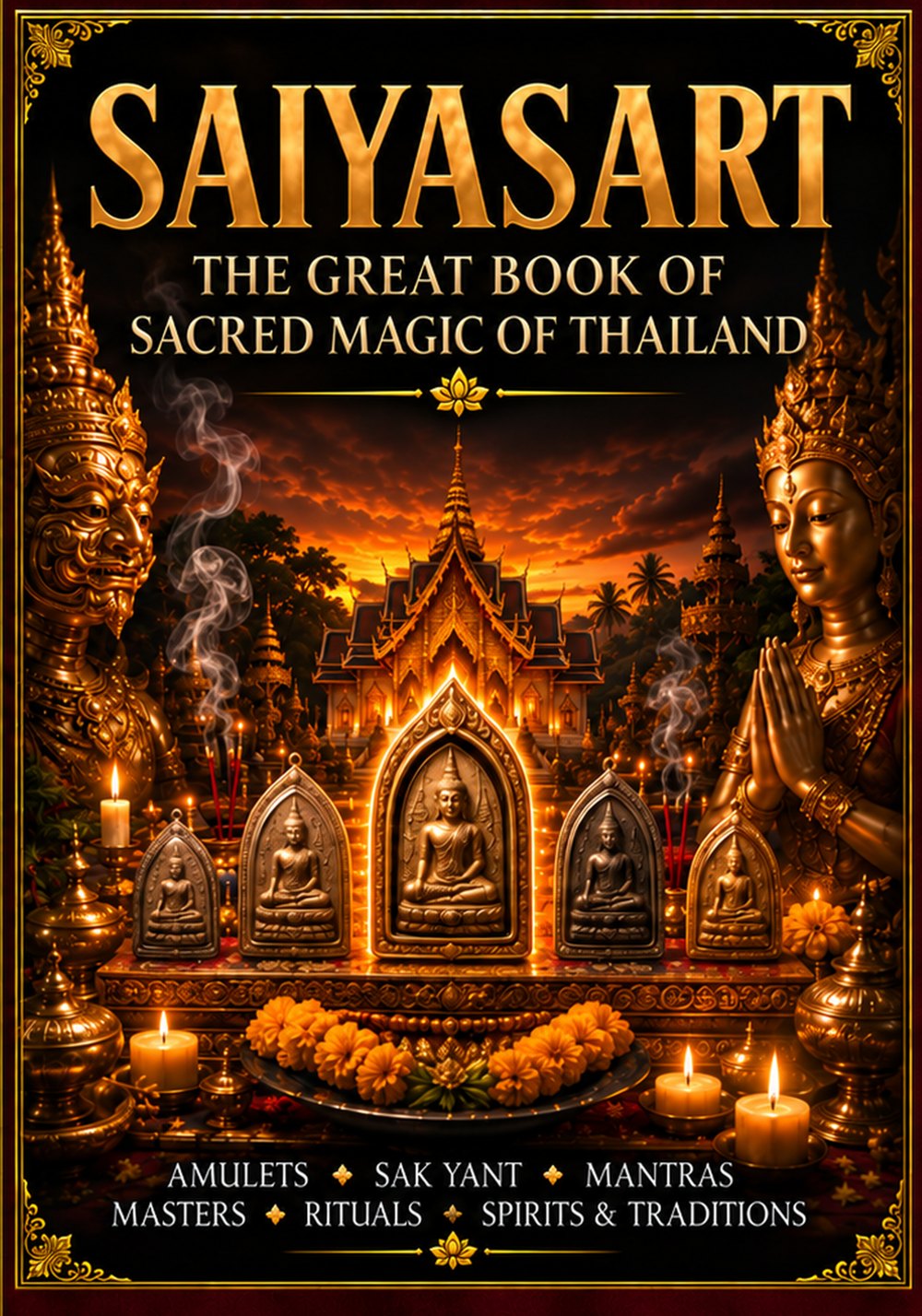
This page covers only a small part of SAIYASART — The Great Book of Sacred Magic of Thailand: 33 chapters in full colour, 30 families of amulets and talismans, and a 120-term glossary.