Spirit houses and altars
One pillar or four, how many incense sticks, why water is poured: the sacred gestures of everyday Thai life.
The small house perched on a pillar — in the corner of a garden, in front of an office building, at a petrol station or in the middle of a rice field — is probably the most visible ritual object in Thailand. But a Thai home actually has two distinct sacred spaces, which must not be confused: the spirit house outside, and the Buddha altar inside.
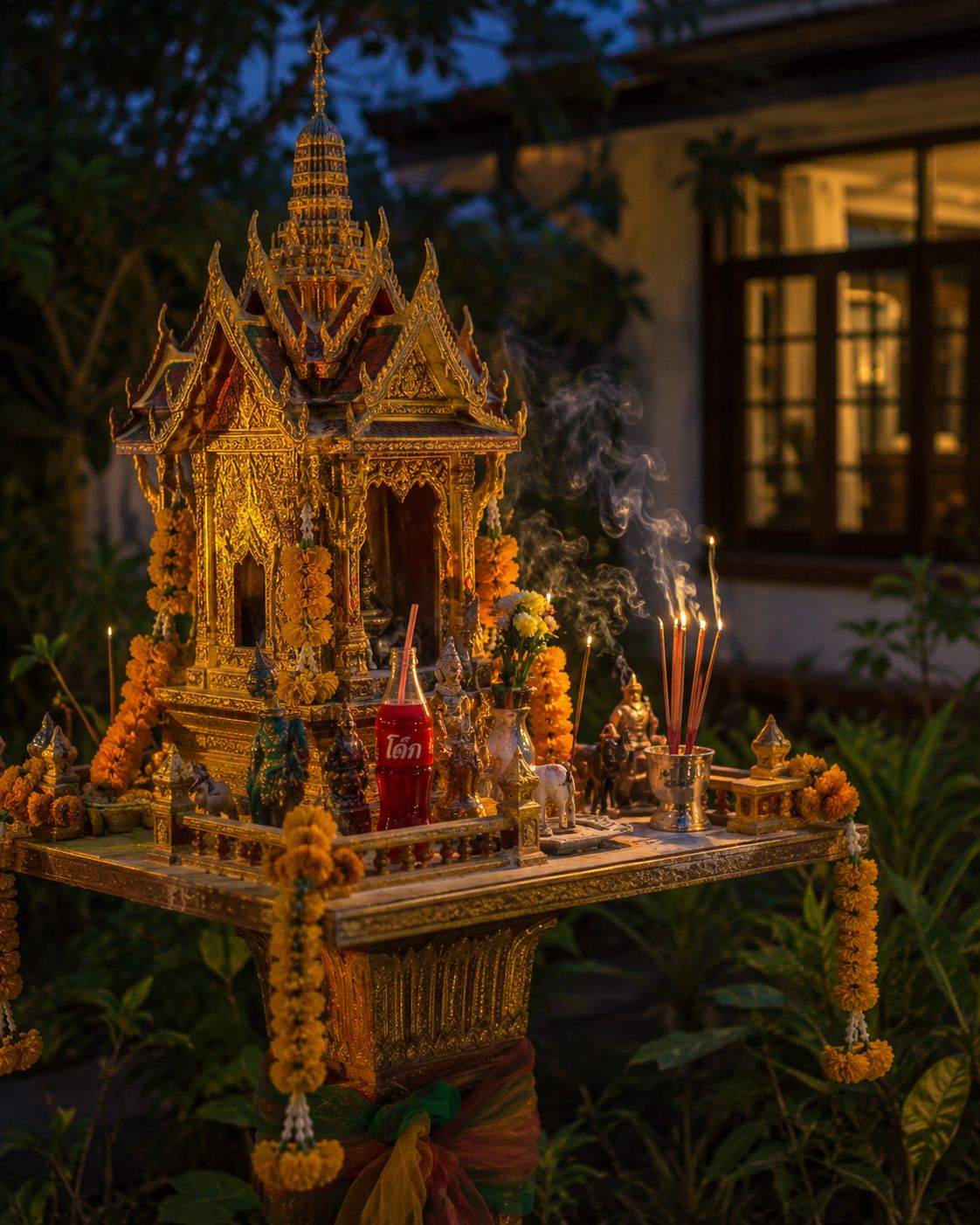
The spirit house (Saan Phra Phum)
Saan Phra Phum means “the dwelling of the lord of the place”. The principle is simple: every plot of land has a guardian, and when one settles there, one offers it a home rather than driving it out.
The number of legs is therefore information, not decorative whimsy.
SAIYASART, chapter 29
These little houses are not all alike. One meant for a celestial deity stands on a single pillar; those for the genie of the place or wandering spirits have four or more. Learned tradition even distinguishes a hierarchy of guardians by place — homes, city gates, fields, granaries, forests, temples, waterways. A ceremony led by a Brahmanic officiant invites the occupant suited to the trade of whoever builds it.
Two practical rules: the shrine stands outside, never in the shadow cast by the house, nor facing the toilets; and it is never moved without a farewell ceremony.
The Buddha altar
The second sacred space is indoors, raised up, and hosts no spirits: one does not deal with presences there, one pays homage. It traditionally takes the form of a set of nested tables of decreasing height — five at home, seven or nine in temples. The statue sits at the top; at the lowest level, a bowl of sand or rice receives the incense, flanked by two candles that each carry a meaning.
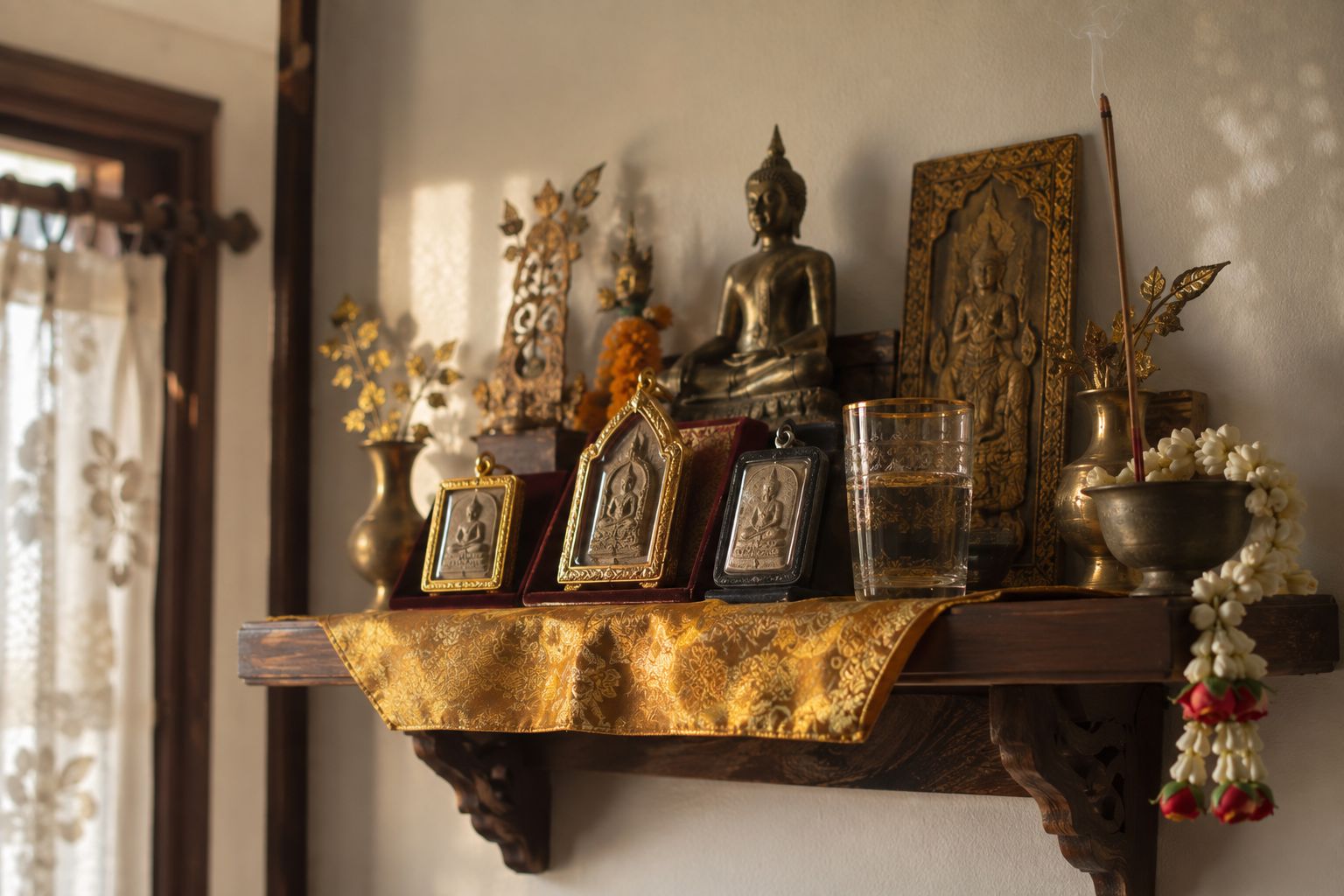
Tradition distinguishes two kinds of homage: the material offering (incense, flowers, food) and homage through practice — meditation and conduct — the only one the Buddha called truly supreme.
Incense: how many sticks?
One of the most useful codes for a visitor, because a mistake is immediately visible:
| Number | For whom |
|---|---|
| 1 | The dead and spirits — the incense of funerals and of the genie of the place |
| 3 | The Three Jewels: the right number before an image of the Buddha |
| 9 | The nine qualities of Awakening and the tree deities |
| 16 or more | Solemn invitations to the deities during ceremonies |
Offering a single stick before a Buddha is, in Thai eyes, an embarrassing slip. When in doubt: three before the Buddha, one before the spirit house. The colour of candles and incense also follows the day of the week — red on Sunday, yellow on Monday, pink on Tuesday, green on Wednesday, orange on Thursday, blue on Friday, purple on Saturday.
Poured water (Kruat Nam)
Every visitor has seen it without understanding: at the end of an offering to monks, the faithful slowly pour a thin stream of water into a bowl while the monk chants. The usual misreading is that one is giving the dead something to drink. The water is not the offering but the vehicle: what is passed on is the merit just acquired, dedicated to the dead, to suffering beings, and to all beings without exception. The earth that receives the water serves as witness.
Frequently asked questions
How many incense sticks before a Buddha?
Three, for the Three Jewels. A single stick is for the dead and for spirits: offering one before a Buddha is a faux pas. When in doubt: three before the Buddha, one before the spirit house.
Why do some spirit houses have four pillars?
The number of legs tells you the occupant: a single pillar for a celestial deity (the Saan Phra Phum proper), four or more for the genie of the place or wandering spirits.
Can a spirit house be moved?
Not without a farewell ceremony that releases the occupant and invites it to move on. That is why abandoned little houses are sometimes seen that no one dares touch.
Go further with the book
This page covers only a small part of SAIYASART — The Great Book of Sacred Magic of Thailand: 33 chapters in full colour, 30 families of amulets and talismans, and a 120-term glossary.