Phra Somdej
The amulet of Somdej Toh: its history, its recipe, its place in the Benjapakee and how experts recognise it.
If a single amulet had to sum up the whole prestige of this art, it would be this one. The Phra Somdej shines neither with gold nor ornament: a silhouette of the Buddha in meditation, seated on stylised steps beneath an arch. That restraint, in connoisseurs' eyes, is precisely what makes it a masterpiece of spiritual simplicity — and, over time, the most sought-after and most expensive piece on the Thai amulet market.
Somdej Toh, the monk who became a legend

Somdej Phra Phuttajarn (Toh) Phrommarangsi was born in 1788, under Rama I, barely seven years after the founding of Bangkok. His biographers agree neither on his birthplace nor on his mother's name, and the silence about his father fed a never-proven rumour of royal descent.
The rest is better established. A novice at twelve, he studied at Wat Rakang, where his memory and mastery of Pali earned him the nickname “the great Toh”. He long avoided honours, preferring study and years of ascetic wandering. Yet it was he who taught Prince Mongkut during his years in robes; once King Rama IV, Mongkut raised him to the rank of Somdet Phra Phutthachan. Tradition also credits him with the Kata Chinabanchorn, the “cage of the Victors”. He died in 1872, aged eighty-four, on the building site of the great standing Buddha of Wat Intharawihan, which he would not see finished.
What a Phra Somdej looks like
It is a small votive tablet made from a paste of lime and sacred ingredients. The Buddha sits in meditation on a stepped base, framed by an arch — the Sum — shaped like a bell, echoing the name of Wat Rakang, the “temple of the bell”.
A recipe before an image
What makes a Phra Somdej is first its material, the Muan Sarn: lime from calcined shells, rice from the alms bowl, flower pollen, temple powders, and five ritual powders — the Pong Phutthakhun — made by writing and erasing sacred formulas in Khom script on a slate, over and over.
Somdej Toh did not invent this science. Tradition says he received it, during his wandering years, from a Lopburi master named Ajarn Saeng of Wat Mani Chonlakhan, who had himself read it on a stone tablet unearthed from a stupa at Sukhothai.
The generations after Somdej Toh
Pieces made in his lifetime form the first great generation. After his death, disciples and abbots of neighbouring temples used the same recipe for their own series, sometimes mixing fragments of old broken amulets into the paste to extend the original blessing. A whole genealogy of Phra Somdej grew up through the 20th century, each tied to a temple, a master and an era.
King of the Benjapakee
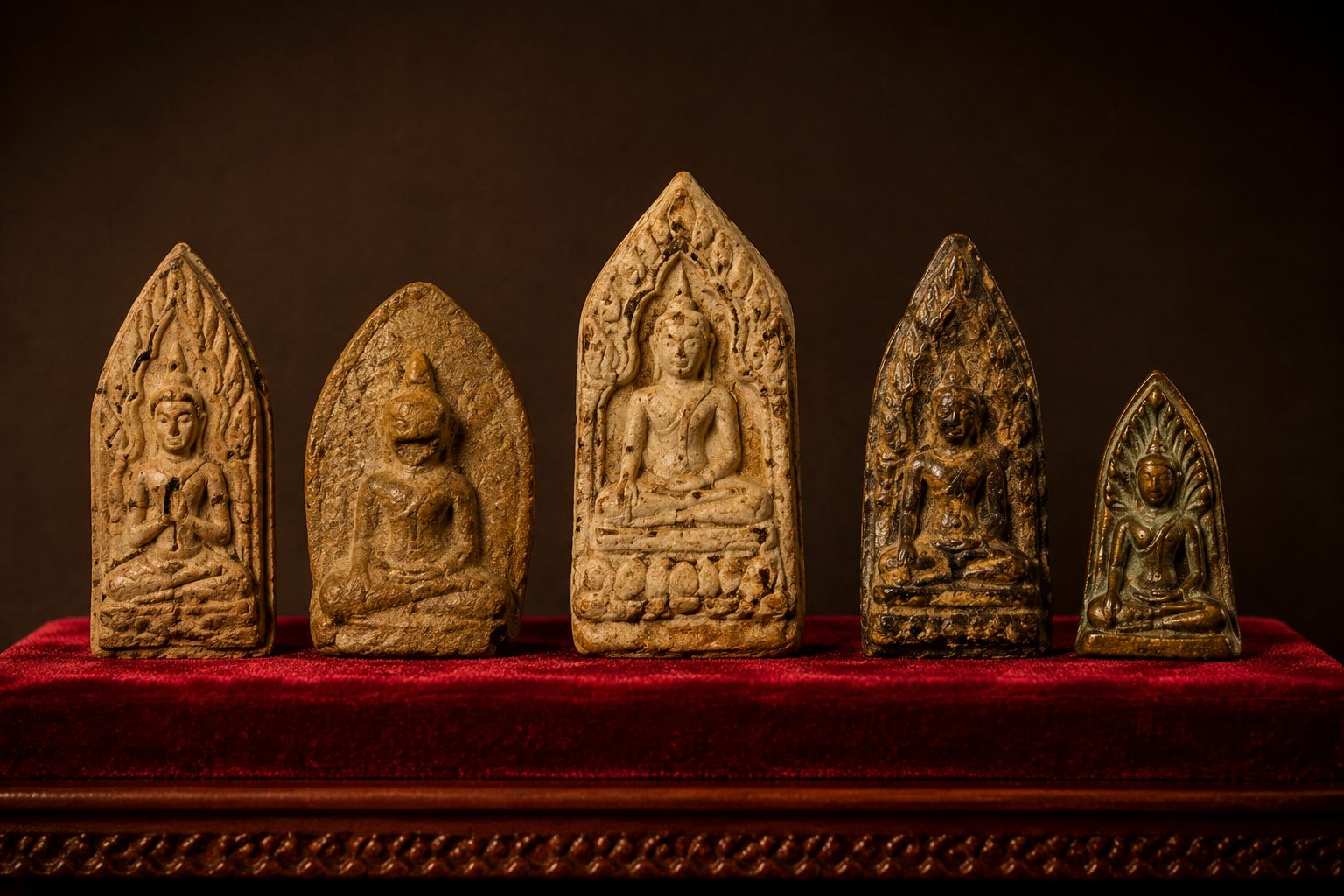
The Phra Somdej belongs to the Benjapakee, “the five associates”, the ranking of the five supreme amulets formalised around 1952. Contrary to a widespread idea, it is neither the oldest nor their source: it is the youngest. The other four are Phra Kru, amulets pressed by the thousand and sealed for centuries beneath a sanctuary before being unearthed, with no known maker.
The Phra Somdej has a known workshop, master, period and recipe: it is, properly speaking, the first signed Thai amulet. That singularity, more than its age, earns it its central place.
It is not a symbolic pantheon: it is a map.
SAIYASART, chapter 5, on the five regions of the Benjapakee
Recognising a genuine Phra Somdej
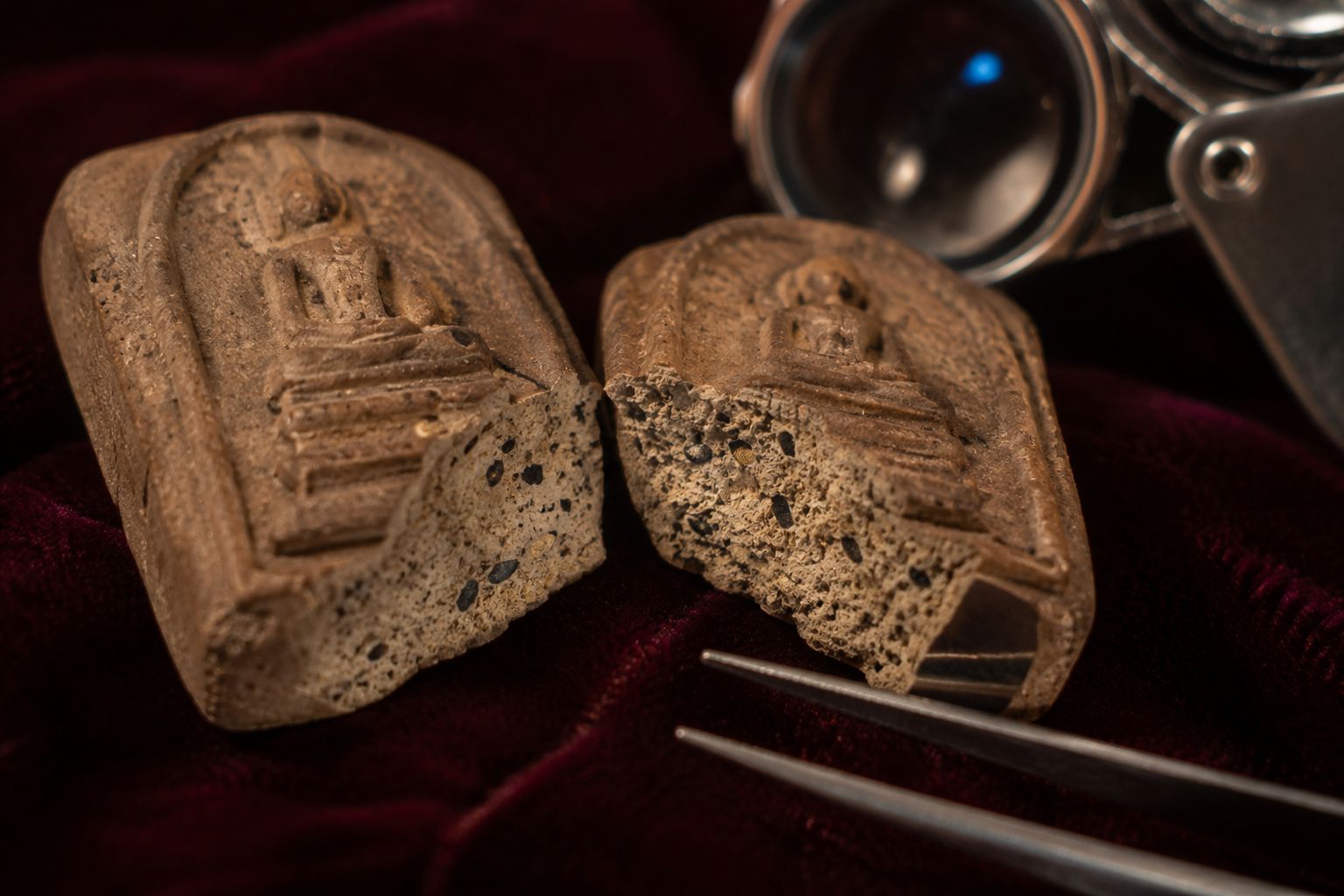
The Phra Somdej is one of the most copied amulets in the world. Thai experts, the Sian Pra, rely on three criteria:
- The mould (Pim) — shape, proportions, the details of each edition.
- The paste (Nuea) — the presence of the components attested in the Wat Rakang workshop.
- Ageing — the natural marks time leaves on the material, which no recent copy truly imitates. This is where the great connoisseurs' skill lies.
The master piece and the “preferred” moulds
Two notions govern the market. The Ongk Kroo, “the master piece”, is an identified, published example against which all others are compared. And experts distinguish Pim Niyom, the moulds the market favours, from Nork Pim, those it ignores. Somdej Toh, tradition says, accepted every mould the craftsmen offered him — so pieces of the same paste and blessing now sell at wildly different prices.
For anyone buying out of devotion rather than speculation, that is good news: a Nork Pim piece, often wrongly taken for a fake, remains affordable.
Advice. A valuable old piece should only be bought with traceable provenance or a certificate that can be verified from a recognised association. The collector's guide explains how to read a listing and check a certification card.
Frequently asked questions
Who created the Phra Somdej amulet?
The first Phra Somdej came from the monastic workshop of Somdej Phra Phuttajarn (Toh) Phrommarangsi, abbot of Wat Rakang in Bangkok in the 19th century (1788–1872).
Why is the Phra Somdej so expensive?
Because it is the most prestigious of the Benjapakee, pieces made in Somdej Toh's lifetime are rare, and the market prizes certain moulds (Pim Niyom) far above others. Genuine pieces from less sought-after moulds (Nork Pim) remain affordable.
How can you tell a genuine Phra Somdej?
Experts (Sian Pra) combine three criteria: the mould, the composition of the paste and the natural signs of ageing — the hardest to fake. They also compare the piece with a published reference example, the Ongk Kroo.
See also: the 30 families of amulets and talismans · the glossary.
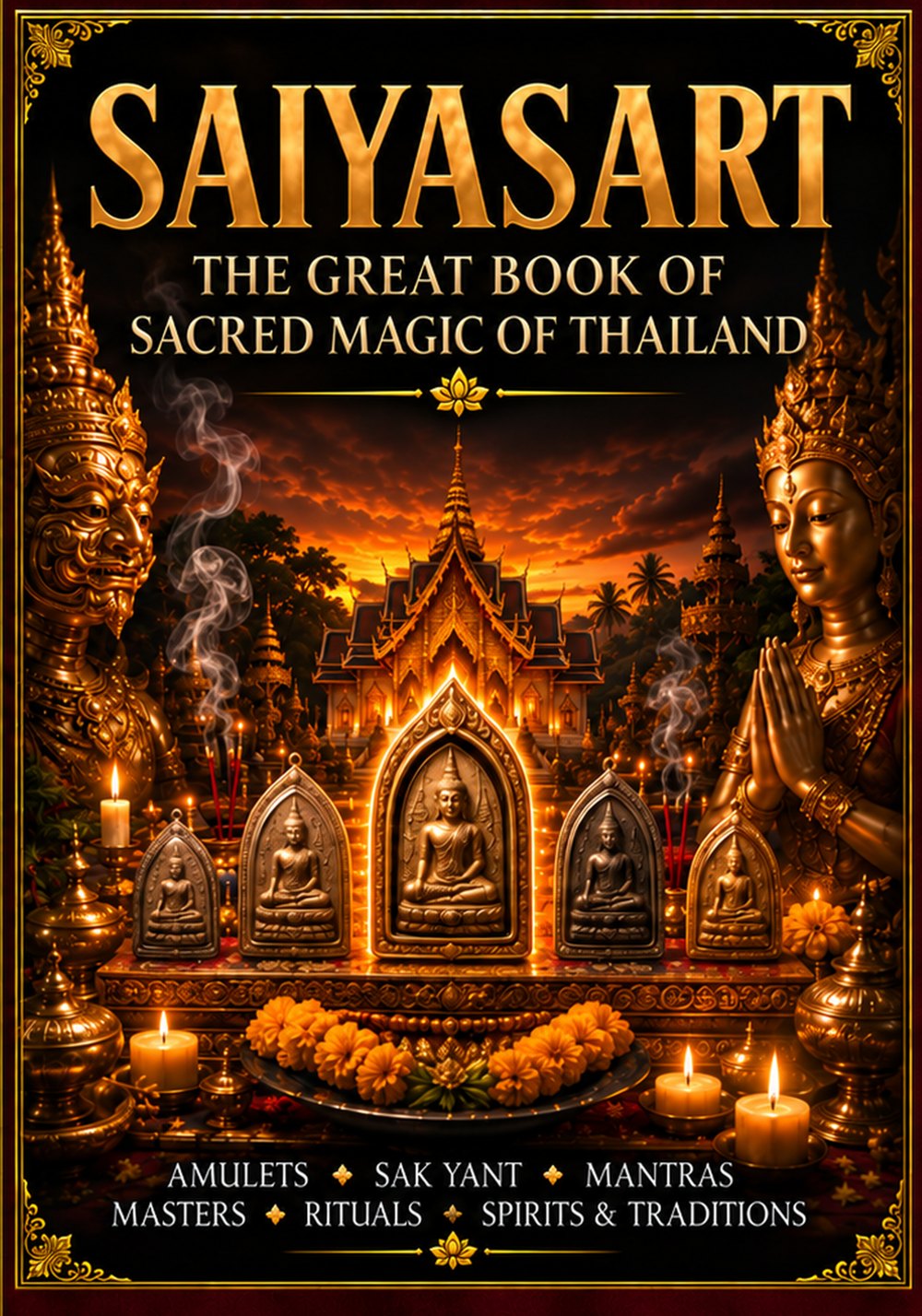
Go further with the book
This page covers only a small part of SAIYASART — The Great Book of Sacred Magic of Thailand: 33 chapters in full colour, 30 families of amulets and talismans, and a 120-term glossary.