Thai amulets and talismans
Buddhas, deities of fortune, sacred objects, effigies and mythological guardians: an overview of Thai amulets, and the difference between amulet and talisman.
Anyone who has travelled in Thailand has seen them: around a taxi driver's neck, on a tuk-tuk dashboard, set in gold on a shopkeeper's wrist. Thai amulets are not souvenirs. You don't buy one the way you buy a lucky charm: you receive it, choose it, sometimes inherit it — and above all you respect it. Amulets never replace effort, virtue or practice; they are a support and a reminder.
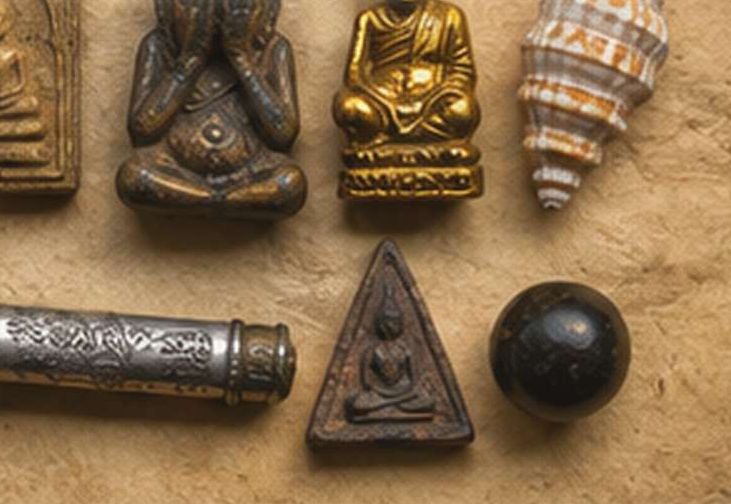
Amulet or talisman: Phra and Krueang Rang
One distinction is almost always blurred in commercial listings, and it changes a great deal. On one side, Phra: Buddhist objects consecrated by monks and tied to the temple network. On the other, Krueang Rang: talismans of animist or Brahmanic origin, made and charged by lay masters, the Ajarn, in the traditions of Saiyasart, with no direct link to the monastic community.
Both coexist easily in daily life — the genius of a culture that never set Theravada Buddhism against its older animist foundation. But they serve different purposes and are honoured in different places: mixing them up indiscriminately is a misleading simplification.
The main powers sought
| Thai term | Power | Examples |
|---|---|---|
| Kong Grapan Chadtri | Resistance to weapons and projectiles | Phra Somkor, Phra Phong Suphan |
| Klaew Klaad | Escaping danger by avoiding it rather than resisting it | Phra Rod |
| Choke Laap | Luck and material prosperity | Nang Kwak, Chuchok, Phra Sivali |
| Maha Sanaeh | Charm and attraction | Phra Khun Phaen, In Koo, See Pherng |
| Maha Amnaj | Authority, natural ascendancy | Sought by those who lead or teach |
| Metta Mahaniyom | Sympathy, popularity, trust | Often paired with Maha Amnaj |
Protection remains, historically, the very first function of Thai amulets — long before luck or seduction — and the most universal reason to wear one every day.
The 30 major families of amulets and talismans
Here is the classification by shape and figure that the book offers as a visual aide-memoire. Names follow collectors' usage; the other common spelling is given in brackets.
Buddhas and sacred figures
- Phra Somdej
- The “king of amulets”: a plain votive tablet of sacred powder, born in Somdej Toh's workshop in the 19th century.
- Phra Pidta
- The Buddha covering his face — or the body's nine openings — with his hands: closing the senses for meditative absorption. Spiritual protection rather than an invisibility charm; the four-, six- or ten-armed Mahahut forms are reputed for invulnerability.
- Phra Kring (Kling)
- A seated Buddha holding a sealed bead; health and prosperity.
- Mae Thorani
- The Earth goddess wringing out her hair to drown the forces of evil; health, fertility, grounding.
- Phra Khun Phaen
- Charm, charisma and protection, in the wake of the semi-legendary hero of the epic Khun Chang Khun Phaen.
- Luang Phu Thuad
- Legendary monk of the 16th–17th centuries; strong protection and support for meditation.
Deities of prosperity and luck
- Nang Kwak (Nang Gwak)
- The lady who beckons customers and fortune into a shop with a wave of her hand.
- Chuchok
- The cunning old beggar of the Vessantara Jataka, figure of the knack for closing a sale.
- Jatukam Ramathep
- A deity hugely popular in the South, protector and bringer of success.
- Phra Prom (Brahma)
- The four-faced god: protection and prosperity in every direction.
- Phra Sivali
- The disciple the Buddha declared foremost in receiving offerings, shown as a wandering monk with bowl and parasol.
- Tao Vessuvan
- The Thai form of the Indian god Kubera: fortune and protection against black magic.
Sacred objects and substances
- Takrut
- A thin scroll of metal — copper, silver, gold or lead — inscribed by a master, then rolled and sealed. Once sewn into soldiers' belts.
- Lek Lai
- A legendary mineral said to be alive; among the most coveted objects… and the hardest to authenticate.
- Bia Gae (Bia Kaew)
- A shell-shaped amulet containing mercury; rare, protection against black magic.
- Look Om
- A small bead of compressed sacred powders; the most famous are attributed to Somdej Toh.
- Sarira relics (Phra That)
- Crystallised pearls from the cremation of the Buddha or great masters: objects of veneration for the altar, not lucky charms to wear.
- Mane Kord stones
- Fossilised sediments held sacred; protection and ritual healing water.
Spirits, effigies and protectors
- Kuman Thong (Gumarn Tong)
- The “golden child”, a protective household effigy treated almost like a child.
- Phra Ngang
- A small effigy inhabited by a powerful spirit; occult charm and protection, daily worship required.
- Hoon Payon
- An effigy animated by a warrior spirit, guardian of the home and its occupants.
- Palad Khik (Bpalad Khig)
- A phallic talisman inherited from the Lingam cult. Its name means “the one who stands beside”: worn at the belt for favour, trade and luck — the fertility-only reading is a Western simplification.
- In Koo
- A paired effigy from Lanna, belonging to charm magic (Maha Sanaeh): an animist talisman, not an object consecrated by monks.
- Ruesi (Lersi)
- The forest hermits, masters of plants and occult knowledge; protection and spiritual development.
Mythological guardians and objects of veneration
- Naga
- Serpent-dragon guarding waters and underground treasures; protection, especially when travelling.
- Garuda
- Mythical bird, mount of Vishnu: power, authority, protection against occult forces.
- Phra Pirab (Bhairava)
- A fearsome form of Shiva; great protection and fortune in exchange for regular offerings.
- Magic belt
- Cloth or leather inscribed with Yant, worn against the skin to protect the whole body.
- Nariphon (Makkali Phon)
- Legendary tree of the Himapant forest bearing fruit shaped like young women. Objects sold under this name are bazaar curiosities, not a true family of consecrated amulets.
- Phra Puthabat
- The Buddha's footprint: an object of pilgrimage, protection and remembrance.
Tradition counts dozens more figures — Phra Pikanes, Phra Rahu, Singha, Salika, Malaeng Phu… The Magie-Thaï shop shows many real examples, each described with its temple, master and year.
How an amulet is born
An amulet from a temple or a recognised master is not an object blessed with a quick gesture. First the sacred ingredients, the Muan Sarn, are gathered, moulds engraved and pieces shaped; then comes the consecration, the Puttapisek, in five stages: the chanting of mantras by monks linked to the amulets by a long white silk thread, the dance of adoration of the Devas, the supplication to Brahma, the lighting of the victory candle, and finally the charging of the amulets by the monks' meditation. The process can take months — which is why a truly consecrated amulet has nothing in common with mass-produced charms.
To learn how to recognise a genuine piece and avoid fakes, see the collector's guide.
Frequently asked questions
What is the difference between a Thai amulet and a talisman?
Phra are Buddhist objects consecrated by monks in temples; Krueang Rang are talismans of animist or Brahmanic origin, made and charged by lay masters (Ajarn). Both coexist in popular practice, but they serve different uses.
How do I choose a Thai amulet?
Tradition advises choosing according to the intention that matches a real need — protection, serenity, success, healing a relationship — rather than rarity or price. A modest amulet chosen sincerely is worth more, in the Thai view, than a prestigious piece worn without conviction.
How many amulets can you wear at once?
Most are worn around the neck, alone or in a small set; three pieces at most is a common convention, beyond which their energies are sometimes thought to cancel out rather than add up.
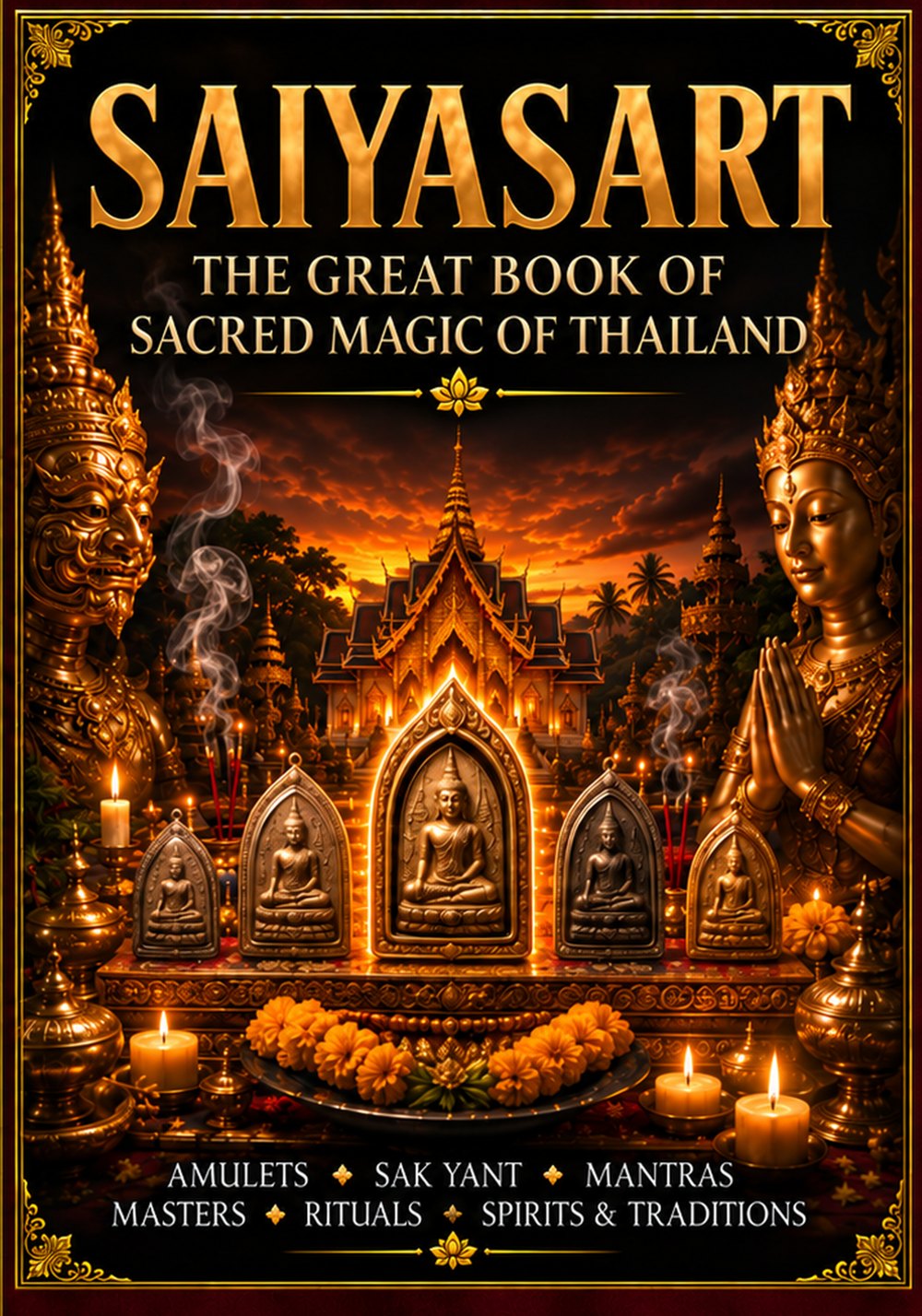
Go further with the book
This page covers only a small part of SAIYASART — The Great Book of Sacred Magic of Thailand: 33 chapters in full colour, 30 families of amulets and talismans, and a 120-term glossary.